Modern Poverty (Landing + App)
- Current status
- Figma app MVP preparing for user testing
- Project type
- Solo
- Timeline
- 1 day for the landing page; app MVP built in Figma and preparing for user testing
TLDR
Modern Poverty started with a domain I found at an auction for $2. The name itself was interesting, so of course I bought it since I already envisioned what the site could become. The first idea was an interactive view of poverty, which I developed and deployed. I later changed direction after remembering a subscription tracker I had designed a few months earlier that, in a strange way, also fit the name.
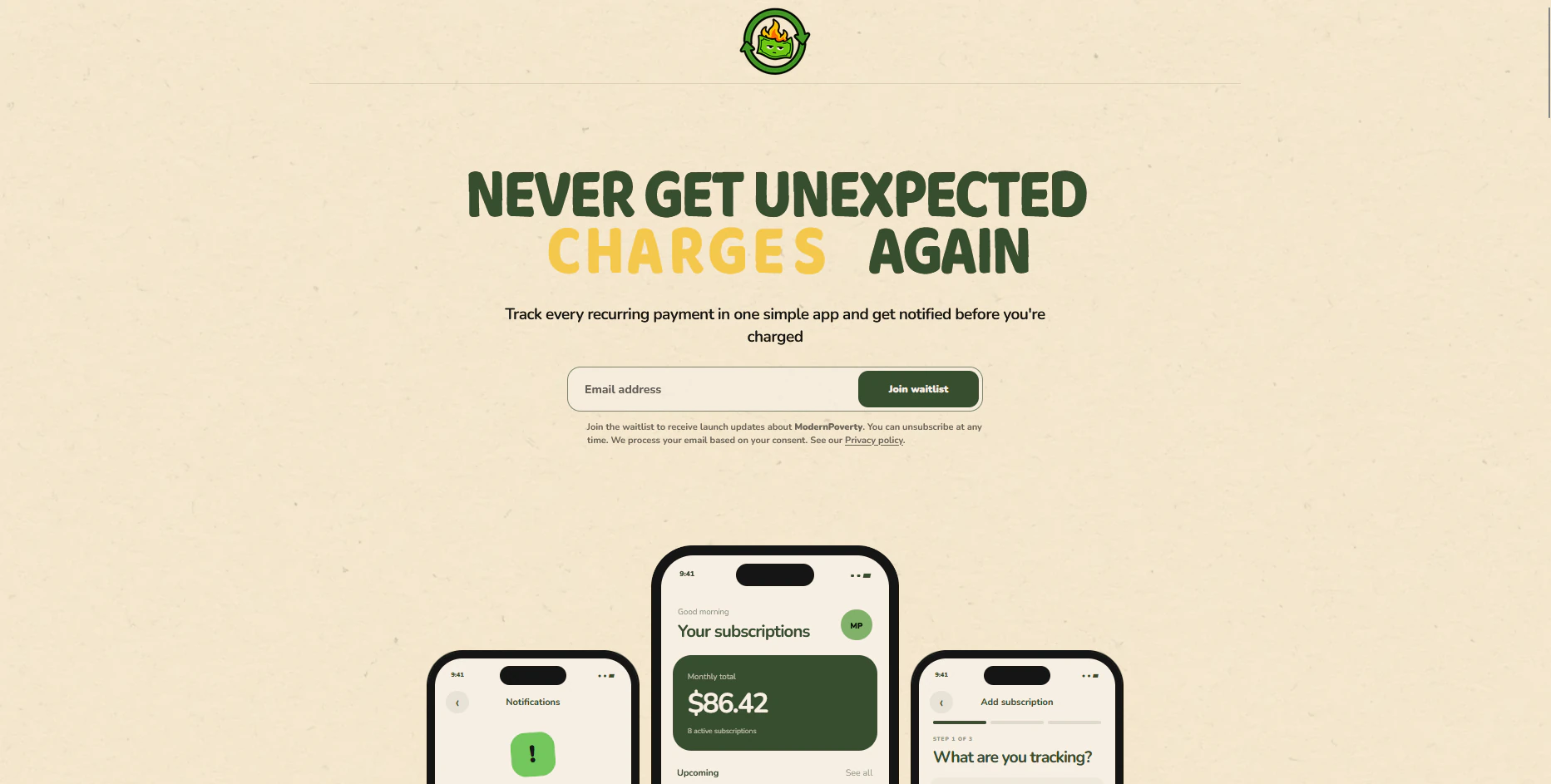
A subscription tracker is obviously not a new idea, and the area is extremely saturated. This was also why I left the design alone for a couple of months. But subscriptions are becoming a part of almost everything, and I have indeed forgotten about one until the renewal appeared. So I returned to the project, created a new landing page in one day and continued working on the app MVP in Figma.
The prototype is now being finished before I test it with users. A saturated idea can still solve a real problem, but you never actually know until people use it.
Where it started
The domain was originally meant for an interactive experience where people could learn about poverty through a three dimensional map. I developed and deployed that idea, but the project eventually stopped moving forward.
Could the name only be used for poverty in the traditional sense? Of course not. Modern poverty can also describe the smaller systems that slowly take money from people without feeling significant on their own. A streaming service here, a software subscription there and perhaps something you signed up for once and completely forgot about. The subscription tracker I had already designed began to make sense under the same name, so the project changed direction.
Why subscriptions
Everything is slowly becoming a subscription because it is a profitable model. People tend to set and forget, which works well for a company collecting recurring payments. Then one day another renewal appears.
You can clearly see the amount and the company on the transaction, so identifying who charged you is not really the issue. The issue is forgetting that the subscription was still active in the first place. Classic.
Banks already have access to the transaction data required to identify recurring payments, but my bank still does not turn this into a useful subscription overview. Perhaps there is simply not enough value in building one for them, or helping customers find and cancel recurring payments could work against their own interests. This is an assumption, of course, and not something the project has proven.
Returning to the idea
I built the first app MVP before the current wave of AI assisted development. The subscription market was already saturated, so leaving it as a design was an easy decision at the time. Why build another tracker when so many already exist?
AI has now made finishing and testing the product more practical and feasible for a solo person. Research can say one thing, but you never actually know for certain whether an idea works for people. Being able to reach a testable prototype without spending as much time changes that calculation. It does not make the idea less saturated, but it makes exploring it less costly.
Current state
I created the new landing page in one day and built the app MVP in Figma. I am currently finishing the prototype before putting it in front of users.
The first tests need to answer fairly simple questions:
- Do people understand the purpose of the product?
- Can they add and review their subscriptions without the flow becoming another task to manage?
- Does the overview reveal anything their banking app does not already make clear?
- Is the product useful enough to return to after the first setup?
Reflection
Modern Poverty has already been two different products under the same name. The first was developed and deployed, whilst the second began as an app design that sat untouched for months. Perhaps the project will change again after testing.
That is fine. The point of returning to it is not to prove that a subscription tracker is an original idea. It clearly is not. The point is to see whether this version gives people a more useful view of something that is already happening around them. If it does, I can continue. If it does not, then at least the answer came from reality rather than another assumption.